
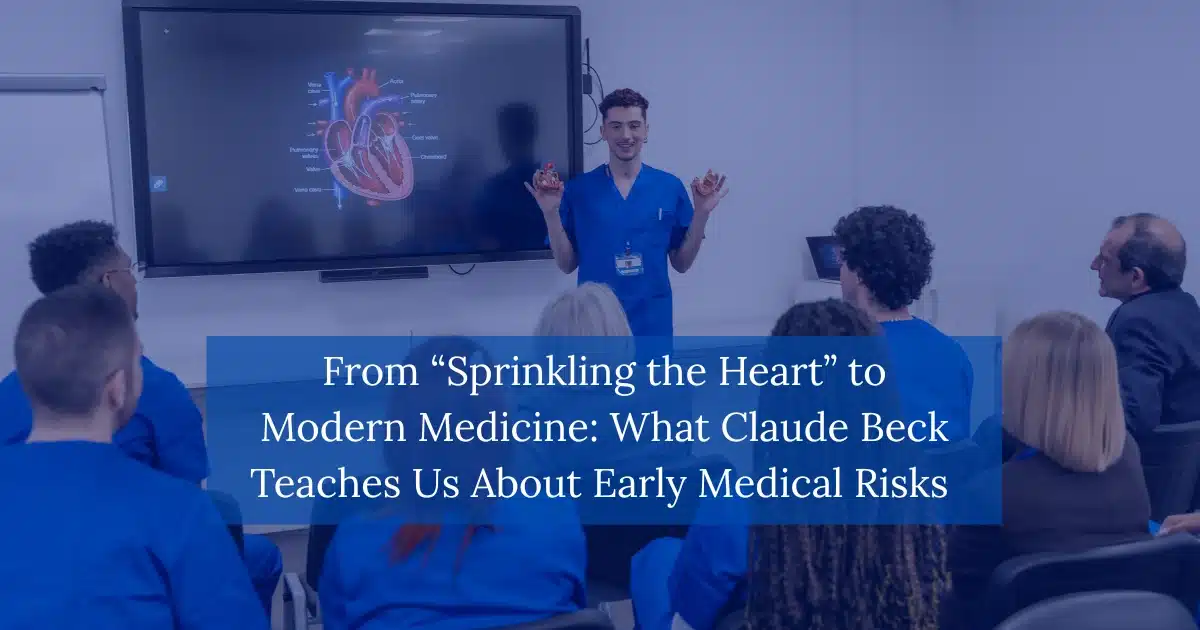
At the recent Tampa conference, our team had the opportunity to hear this fascinating topic explored in greater depth during a discussion on the history of experimental medical practices and their broader implications. The presentation offered valuable insight into how early innovations in medicine often carried risks that were not fully understood until years later. We found the parallels between these medical experiments and the history of asbestos exposure especially compelling, and we wanted to share what we learned with our readers to highlight the importance of risk awareness, scientific advancement, and protecting public health.
In the 1930s, Dr. Claude Beck pioneered an audacious procedure known as “sprinkling the heart”, applying powders directly to the exposed heart during surgery to stop arrhythmias. These powders like salts, electrolytes, and other stimulants were experimental and designed to coax the heart back to a normal rhythm. At the time, surgeons had little understanding of the full risks, and the procedure carried significant potential for harm.
This willingness to experiment with new substances underlines an important lesson for modern medicine: even substances intended to heal can carry hidden dangers. Just as early surgeons learned to balance risk with innovation, society has learned similar lessons in industrial contexts, most notably with asbestos.
Asbestos, a naturally occurring mineral prized for its heat-resistant properties, was widely used in insulation, construction, and manufacturing. Like the powders Beck sprinkled, asbestos seemed beneficial until long-term effects revealed its deadly consequences, including mesothelioma, asbestosis, and lung cancer. Workers handling asbestos were unknowingly exposed to microscopic fibers that could cause disease decades later, much like early cardiac patients were unknowingly exposed to untested powders.

Beck’s work reminds us that risk assessment is critical, whether in surgery or industry. Modern medicine now meticulously tests drugs, therapies, and surgical techniques to prevent unintended harm. Likewise, asbestos regulations and bans aim to protect workers and families from exposure, demonstrating how awareness of hidden risks transforms both healthcare and public safety.
While “sprinkling the heart” is a relic of early cardiac surgery, it offers a powerful parallel: what seems safe or helpful in the short term may harbor serious long-term consequences. Just as surgeons learned from Beck’s experiments, society continues to learn from asbestos exposure, reinforcing the importance of caution, regulation, and scientific inquiry.
If you or a loved one has been affected by asbestos or mesothelioma, you can call (800)-505-6000 or fill out our contact form for legal guidance.